History · 1859 to today

One battlefield, one book, and the rules every nation signed.

The Red Cross did not start with a government or an army. It started with a Geneva businessman who arrived after a battle, saw thousands of wounded men left to die, and refused to accept that this was normal.

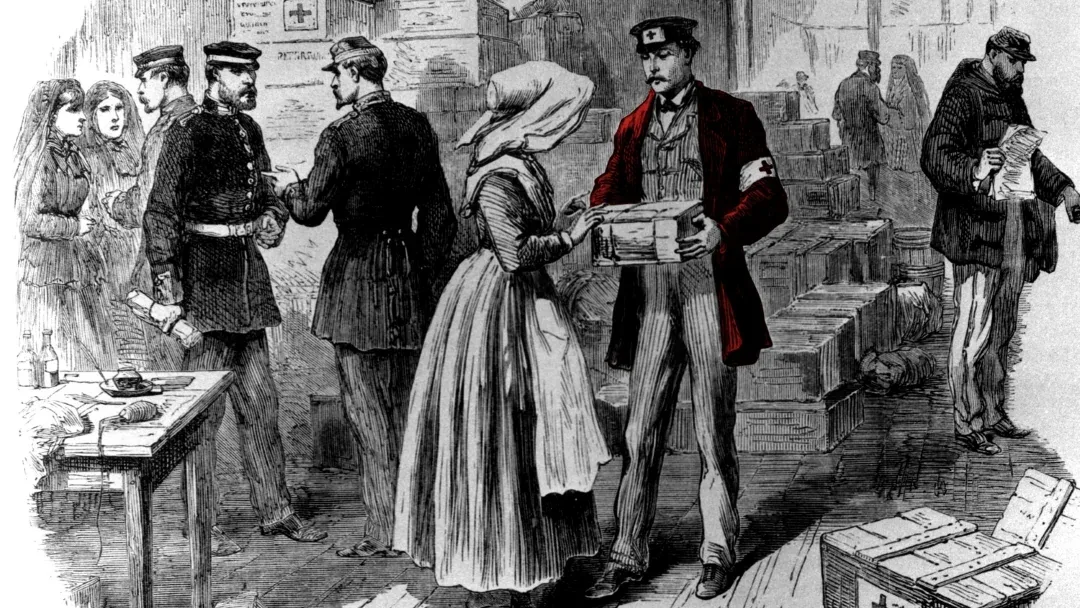
19th-century engraving: volunteers wearing white armbands marked with a red cross hand out boxes of supplies in a crowded depot, while soldiers and nurses talk nearby.
Early Red Cross volunteers at work, 19th-century engraving. Image: British Red Cross.

The story

How an idea became a movement.

24 June 1859
Solferino, Lombardy

The battle

In the summer of 1859, France and the Kingdom of Piedmont-Sardinia were at war with the Austrian Empire over the future of northern Italy. On 24 June, more than a quarter of a million soldiers met near the village of Solferino, south of Lake Garda. By nightfall some 40,000 men lay dead, dying or wounded across the hills.

The armies' medical services were tiny and quickly overwhelmed. Wounded soldiers lay where they fell, often for days, without water, dressings or anyone to help them.

Henry Dunant, a 31-year-old businessman from Geneva, was not there to fight. He had travelled to Lombardy to ask Emperor Napoleon III for help with land and water rights for his company in French-ruled Algeria. He arrived on the evening of the battle and found himself among the wounded.
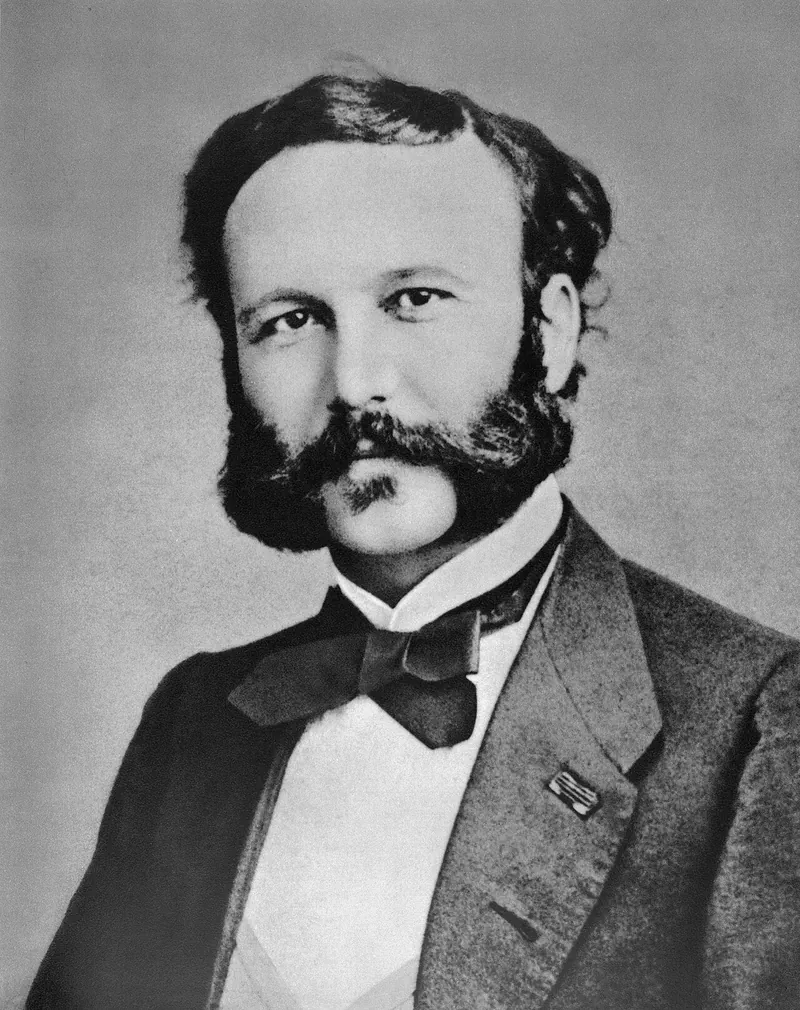
Black-and-white photographic portrait of a young Henry Dunant with dark hair and side whiskers, wearing a dark coat and cravat.
Henry Dunant (1828–1910), around 1863. Public domain, via Wikimedia Commons.

June–July 1859
Castiglione delle Stiviere

“Tutti fratelli”

Thousands of the wounded were carried to the nearby town of Castiglione. Dunant stayed. In the town's main church, the Chiesa Maggiore, he organised local people, mostly women, to wash wounds, bring water, write letters home and sit with the dying. He bought supplies with his own money.

They cared for French, Italian and Austrian soldiers alike. The women of Castiglione had a phrase for it, which Dunant repeated to anyone who hesitated: tutti fratelli, “all are brothers.” That idea, that a wounded enemy is no longer an enemy, is the root of everything that followed.

1862
Geneva

A Memory of Solferino

Back in Geneva, Dunant could not put what he had seen behind him. In 1862 he published Un souvenir de Solférino (A Memory of Solferino), paying for 1,600 copies himself and sending them to political and military leaders across Europe.

The book did more than describe horror. It ended with two practical proposals: every country should set up a volunteer relief society, trained in peacetime, ready to care for the wounded of any side in war; and states should agree on an international rule that would protect those volunteers and the wounded they cared for.

Would it not be possible, in time of peace and quiet, to form relief societies for the purpose of having care given to the wounded in wartime by zealous, devoted and thoroughly qualified volunteers? Henry Dunant, A Memory of Solferino, 1862 (English translation)

17 February 1863
Geneva

The Committee of Five

The book reached the Geneva Society for Public Welfare, a local charity led by the lawyer Gustave Moynier. It set up a small committee to study Dunant's proposals. That committee met for the first time on 17 February 1863, the date now counted as the founding of what became the International Committee of the Red Cross (ICRC).

  • Henry DunantBusinessman, author of the idea
  • Gustave MoynierLawyer, later its long-serving president
  • Guillaume-Henri DufourGeneral, its first president
  • Louis AppiaSurgeon with battlefield experience
  • Théodore MaunoirSurgeon

In October 1863 the committee invited governments to a conference in Geneva. Delegates from 14 states agreed that each country should form a relief committee, that volunteers should work under the protection of the armies, and that they should wear one recognisable sign: a white armband with a red cross.

22 August 1864
Geneva

The first Geneva Convention

A year later, the Swiss government called a diplomatic conference. On 22 August 1864, twelve states signed the Convention for the Amelioration of the Condition of the Wounded in Armies in the Field: Baden, Belgium, Denmark, France, Hesse, Italy, the Netherlands, Portugal, Prussia, Spain, Switzerland and Württemberg.

It had only ten articles. But for the first time, governments had signed a permanent, written promise to limit what war may do to people. Wounded soldiers had to be cared for whatever their nationality, and the people caring for them could not be attacked. Read the key articles below.

1867–1910
Paris, Heiden

The founder's fall and return

Dunant's own story then took a harsh turn. In 1867 his businesses collapsed and he was declared bankrupt. Geneva society did not forgive him, and he was forced out of the committee he had inspired. For years he lived in poverty, moving between European cities, largely forgotten.

He eventually settled in the small Swiss village of Heiden, living in its hospital. In 1895 a journalist, Georg Baumberger, found him there and wrote about him, and the world remembered who had started the Red Cross. In 1901 Dunant received the first Nobel Peace Prize, shared with the French pacifist Frédéric Passy. He died in Heiden on 30 October 1910 and left his prize money to charity.

The minimum ground

The Geneva Conventions, in their own words.

The 1864 Convention was revised and extended after each great war. Today's rules are the four Geneva Conventions of 12 August 1949, which every state in the world has ratified, and the Additional Protocols of 1977. These are some of the key passages.

1864 · The first Convention

Convention for the Amelioration of the Condition of the Wounded in Armies in the Field, Geneva, 22 August 1864

Article 1

Ambulances and military hospitals shall be acknowledged to be neuter, and, as such, shall be protected and respected by belligerents so long as any sick or wounded may be therein.

Places that care for the wounded are off limits.

Article 6

Wounded or sick soldiers shall be entertained and taken care of, to whatever nation they may belong.

The tutti fratelli of Castiglione, written into law.

Article 7

The flag and the arm-badge shall bear a red cross on a white ground.

The birth of the emblem: one sign that says “do not attack.”

1949 · The four Geneva Conventions

Adopted 12 August 1949, after the Second World War. Convention I covers wounded soldiers on land, II at sea, III prisoners of war and IV civilians.

Common Article 1 · all four Conventions

The High Contracting Parties undertake to respect and to ensure respect for the present Convention in all circumstances.

Not only to obey the rules, but to make sure others obey them too. In all circumstances.

Convention III · Article 13

Prisoners of war must at all times be humanely treated.

A captured soldier is out of the fight and must be treated as a human being.

Common Article 3 · all four Conventions

Persons taking no active part in the hostilities, including members of armed forces who have laid down their arms and those placed hors de combat by sickness, wounds, detention, or any other cause, shall in all circumstances be treated humanely, without any adverse distinction founded on race, colour, religion or faith, sex, birth or wealth, or any other similar criteria. To this end the following acts are and shall remain prohibited at any time and in any place whatsoever with respect to the above-mentioned persons:
  1. violence to life and person, in particular murder of all kinds, mutilation, cruel treatment and torture;
  2. taking of hostages;
  3. outrages upon personal dignity, in particular humiliating and degrading treatment;
[…] The wounded and sick shall be collected and cared for.

Often called a convention in miniature. It applies even in civil wars, and it sets the floor below which no one may go: the minimum ground.

Convention IV · Article 27

Protected persons are entitled, in all circumstances, to respect for their persons, their honour, their family rights, their religious convictions and practices, and their manners and customs. They shall at all times be humanely treated, and shall be protected especially against all acts of violence or threats thereof […]

Civilians in the hands of an enemy keep their dignity and their rights.

Convention IV · Articles 33 and 34

No protected person may be punished for an offence he or she has not personally committed. Collective penalties and likewise all measures of intimidation or of terrorism are prohibited. […] The taking of hostages is prohibited.

No one may be punished for what someone else did.

1977 · Additional Protocol I

Protocol Additional to the Geneva Conventions of 12 August 1949, relating to the Protection of Victims of International Armed Conflicts

Article 35(1) · Basic rules

In any armed conflict, the right of the Parties to the conflict to choose methods or means of warfare is not unlimited.

There are always rules, and there are always red lines.

Article 48 · Basic rule

In order to ensure respect for and protection of the civilian population and civilian objects, the Parties to the conflict shall at all times distinguish between the civilian population and combatants and between civilian objects and military objectives and accordingly shall direct their operations only against military objectives.

Civilians are never a target.

The 1864 text is quoted from the official United States translation, as published by the Avalon Project at Yale Law School. The 1949 and 1977 texts are the official English versions. Full texts: ICRC international humanitarian law database.

Timeline · 1863 to today

From five men in Geneva to a worldwide movement.

The story of the movement as a whole, from its Geneva committee to the rules that now bind every state.

  1. 1863

    The committee is born. Five citizens of Geneva form a permanent committee on 17 February. In October they bring 36 participants to Geneva, 18 of them sent by governments, who agree on national relief societies, protection for volunteers and one common sign.

  2. 1864

    The first Geneva Convention is signed by 12 states on 22 August. The first national relief societies take shape across Europe, from Belgium and Denmark to France, Prussia, Spain and Württemberg.

  3. 1867

    The national societies meet for their first international conference in Paris. The same year Dunant, now bankrupt, leaves the committee.

  4. 1876

    A name and a second emblem. The Geneva committee becomes the International Committee of the Red Cross. In the Russo-Turkish War, the Ottoman Empire's relief workers use a red crescent.

  5. 1901

    The first Nobel Peace Prize goes to Henry Dunant, shared with Frédéric Passy.

  6. 1906

    The first revision of the 1864 Convention. A year later, the Hague Conventions of 1907 carry its protection to war at sea.

  7. 1914

    A card index for a world at war. On 15 October the ICRC opens its International Prisoners-of-War Agency in Geneva. By 1918 it has passed on some 20 million letters and messages and 1.9 million parcels, and helped identify about 2 million prisoners.

  8. 1917

    Nobel Peace Prize for the ICRC, the only one awarded during the First World War.

  9. 1919

    A federation for peacetime. National societies form the League of Red Cross Societies, today the International Federation of Red Cross and Red Crescent Societies (IFRC).

  10. 1925

    Gas and germs are banned. The Geneva Protocol outlaws the use of poison gas and biological weapons in war.

  11. 1929

    Prisoners of war get their own convention, and the red crescent is formally recognised alongside the red cross.

  12. 1939

    The Second World War. The ICRC's Central Agency builds an index of some 45 million cards and relays about 120 million messages; its delegates make thousands of visits to prisoner-of-war camps. It does not speak out against the Nazi extermination camps, a silence it now calls the greatest failure in its history.

  13. 1944

    A second Nobel Peace Prize for the ICRC's wartime work.

  14. 1949

    The four Geneva Conventions are adopted on 12 August. For the first time, civilians in enemy hands are protected by a treaty of their own.

  15. 1963

    The centenary is marked by a third Nobel Peace Prize, shared by the ICRC and the League.

  16. 1965

    Seven Fundamental Principles are adopted in Vienna for the whole movement.

  17. 1977

    Two Additional Protocols, adopted on 8 June, strengthen the protection of civilians and reach into civil wars.

  18. 1990

    A seat at the United Nations. The General Assembly grants the ICRC observer status, the first private organisation to receive it.

  19. 2005

    A third emblem, the red crystal, is added for those who want a sign free of any national or religious reading.

  20. 2011

    Health Care in Danger. The ICRC launches a global campaign against attacks on hospitals, ambulances and medical workers.

  21. 2022

    Mirjana Spoljaric Egger becomes the first woman to lead the ICRC, on 1 October.

  22. Today

    Every state in the world is party to the 1949 Geneva Conventions, and Red Cross and Red Crescent societies work in more than 190 countries.

Vienna, 1965

Seven principles.

What began as a reaction to one battlefield became seven principles for the whole movement. Here is what each one means in practice, in our words. The official wording is published by the ICRC.

Humanity

The starting point: someone is suffering, and that alone is reason enough to act.

Impartiality

The most urgent case is treated first. Who the person is, or which side they are on, does not change the order.

Neutrality

Helpers stay out of the quarrel, which is what lets them cross front lines that others cannot.

Independence

Governments can be partners, but they do not get to decide who is helped.

Voluntary service

The work is given, not sold. Nobody is meant to profit from it.

Unity

Each country has a single society, which welcomes anyone and serves the whole nation.

Universality

Large or small, rich or poor, every national society counts the same and carries its share.

Why this matters now

It started with one person who would not look away.

Dunant had no army, no office and no mandate. He had a conviction, a book and the patience to persuade governments. The rules his idea produced are still signed by every country on earth. Holding leaders to them is something every citizen can do.

Sources and credits

Read further.